

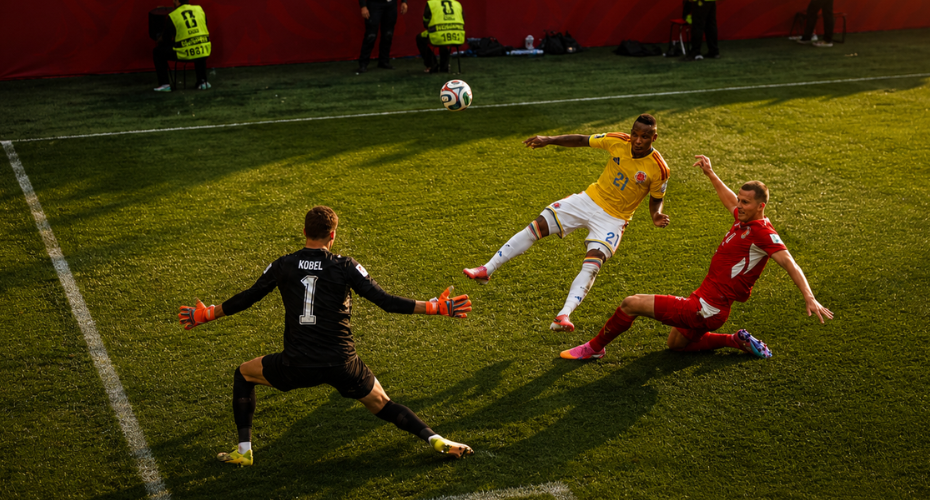
Colombia’s World Cup campaign ended in the agony of penalties against Switzerland, but the story did not stop at the final whistle. Instead, it took an uglier and far more disturbing turn, with Jaminton Campaz and his family receiving death threats after the forward missed a late chance that might have sent Colombia through.
The response from the Colombian Football Federation has been immediate and forceful. Its leadership has condemned the threats in the strongest terms and called on the country’s Attorney General’s Office to investigate and take action as quickly as possible. In isolation, that would already make this a serious and shocking story. In the context of Colombian football history, it feels even heavier.
Colombian federation calls for investigation after threats to Campaz
The Colombian Football Federation, known as the FCF, has publicly demanded legal action after threats were directed at Campaz and members of his family following Tuesday’s elimination.
The federation’s executive committee called on the Colombian Attorney General’s Office to open an investigation and “prosecute and punish” those responsible “as swiftly as possible.”
That demand came after a brutal conclusion to Colombia’s last 16 tie against Switzerland. With the score still 0 0 in the final six minutes of extra time, Campaz broke through on goal with a huge opening to decide the match. He could not keep the effort down and sent his shot over the crossbar.
The tie then went to penalties. Campaz recovered well enough to score his own spot kick, but Colombia still lost the shootout 4 3, ending their World Cup run.
By Friday, the federation had issued a statement saying it “categorically condemns the threats against the life and safety of Jaminton Campaz and his family.”
That language alone shows the scale of the concern. This was not a case of ordinary post match criticism, frustration, or abuse on the edge of sport. It crossed into something far more serious.
The shadow of Andrés Escobar still hangs over Colombian football
What makes the threats against Campaz especially chilling is the history they revive.
They come 32 years after the death of Andrés Escobar, one of the darkest and most painful events the game has ever known. Escobar, the former Colombia defender, was killed after the 1994 World Cup in the United States.
That Colombian side had gone out after finishing bottom of its group. Multiple players received death threats. Escobar, who was 27, had scored an own goal in a defeat to the United States on June 22. On July 2, shortly after returning to Colombia, he was shot dead.
That tragedy has never been forgotten. It remains a wound in Colombian football and a warning of what can happen when the pressure, emotion, and intensity of the game are twisted into violence. The threats against Campaz arrive with that memory sitting heavily in the background.
For football fans, especially those who travel to major tournaments for the atmosphere, the drama, and the shared experience of watching nations compete on the biggest stage, this is the kind of story that cuts through everything else. World Cups are meant to be built on passion, hope, and pride. When a player becomes a target for missing a chance, the sport has moved into dangerous territory.
The FCF’s message was direct and uncompromising
The Colombian federation left little room for ambiguity in its statement.
“No sportsman, nor any member of their camp, should be subjected to intimidation for representing their country in a sporting context,” the FCF read.
It then set out its support for Campaz, his family, and the wider national team group.
“The executive committee of the Colombian Football Federation expresses its full solidarity with and support for Jaminton Campaz, his family, all the players in the Colombia national team and the delegation as a whole. It also calls on the Attorney General’s Office to carry out, as swiftly as possible, the necessary investigations to identify, prosecute and punish those responsible for these acts.
“The FCF reiterates that the players who make up our national teams accept the honour of wearing the Colombian shirt with discipline, commitment, professionalism and a deep love for their country.
“Every time they take to the pitch, they do so with the conviction that they will give their utmost and with the sole aim of representing the nation with dignity and achieving the best possible result.”
There is a wider point in that statement too. International football is emotional by its very nature. Players carry the hopes of millions, particularly in a World Cup where the attention is so intense and every moment can feel permanent. But the federation is making it clear that none of that can ever justify intimidation, let alone threats against a player’s life and safety.
Colombia’s tournament deserved a different ending
The cruelty of the aftermath is made even sharper by the fact that Colombia had put together a strong tournament.
They finished top of Group K, ending two points clear of Portugal. In the last 32, they beat Ghana thanks to a John Arias goal inside the opening 15 minutes. Across the tournament, they did not lose a match in normal time. Their elimination on penalties to Switzerland was their first defeat of the World Cup.
That loss also denied them a quarter final against Argentina, which would have been one of the standout ties of the next round and a match of huge appeal to supporters following the tournament closely.
Campaz himself featured in three of Colombia’s five World Cup matches and scored once, finding the net against Uzbekistan. He was part of a side that had shown resilience, organisation, and enough quality to feel they could go deeper. That matters, because it underlines just how unfair it is to reduce a campaign of that kind to one missed chance at the end of extra time.
Football does not work that way, no matter how often players get unfairly framed as the hero or villain of one defining moment.
A call to protect both players and the values of the game
The federation’s statement ended by broadening the issue beyond Campaz alone and returning to what football is supposed to represent.
“Football must be a space for unity, respect and hope, never a stage for hatred, intimidation or violence,” the FCF statement continued. “For this reason, the federation calls on all Colombians to ensure that the differences inherent in sporting competition never result in threats or attacks against those who dedicate their lives to representing the country.
“Protecting our athletes also means protecting the values of sport and the pride that unites millions of Colombians around the Colombia national team.”
That final line is the one that lingers. Protecting players is not separate from protecting football itself. It is the same thing. The relationship between fans and a national team is often intense, and that intensity is part of what makes World Cups unforgettable for those following them from home or experiencing them first hand through football trips, football weekends abroad, and live matchgoing culture. But when that intensity curdles into fear and violence, the sport loses something essential.
Colombia’s heartbreak should never have become this
Colombia’s exit to Switzerland was painful enough. A missed chance in extra time, a penalty shootout defeat, and the end of a promising World Cup run would have been difficult enough for Campaz to live with on their own. That it has now been followed by death threats is a disgrace.
This is bigger than one result, one player, or one tournament. It is about the line that football must never cross. Players can miss chances. Nations can suffer heartbreak. Supporters can feel devastated. None of that can ever become an excuse for threats, intimidation, or violence against the people on the pitch.
The Colombian federation has made its position clear. It has demanded action, offered its support, and reminded everyone what the shirt is meant to stand for. Now the expectation is that the authorities respond with the same urgency. Because once football drifts into something this dark, silence is not enough.