

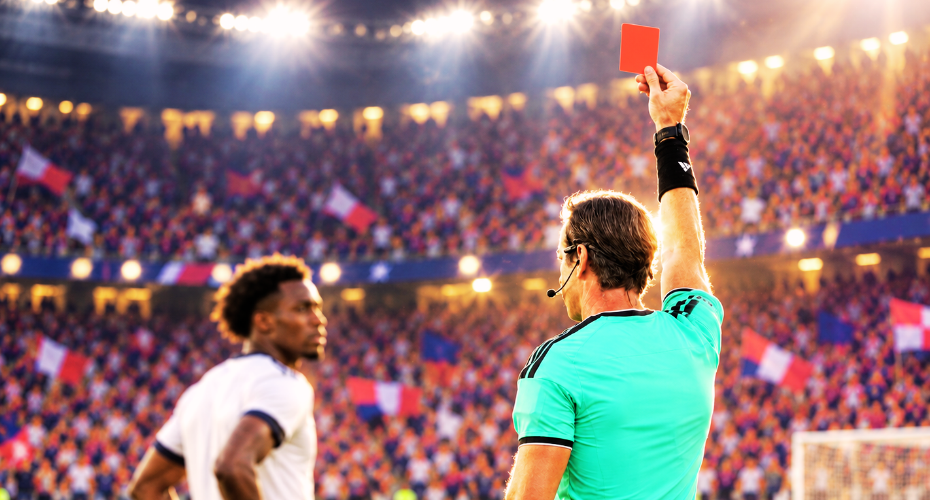
FIFA is preparing to tighten its disciplinary rules after one of the most controversial decisions of the 2026 World Cup, when United States forward Folarin Balogun was allowed to play in the last 16 despite being sent off in the previous round.
The governing body wants to prevent automatic one match bans from being suspended in future tournaments, with a proposed amendment set to go before the FIFA Council at its meeting in Zurich.
The move comes after the Balogun case became one of the tournament’s biggest off pitch stories, involving a call from United States President Donald Trump to FIFA president Gianni Infantino, an unusual review process during the World Cup, criticism from UEFA and wider questions about competitive integrity.
FIFA now wants the regulations to make a repeat far less likely.
FIFA Council set to consider disciplinary changes
The FIFA Council will meet on Thursday for the first time since the World Cup.
The council is the main decision making body within world football’s governing organisation and includes Infantino, eight vice presidents and 28 other members.
At that meeting, members will be presented with a proposed amendment designed to place new limits on the suspension of automatic one match bans.
The proposal says the change is needed “to ensure stability and predictability regarding player eligibility and, therefore, protect the integrity of competitions.”
The idea is straightforward. If a player receives a red card and the competition rules impose an automatic one match suspension, FIFA wants that punishment to remain in place rather than being paused while the tournament continues.
For supporters following major international football, whether from home or as part of football trips and overseas football travel, clarity around player eligibility is fundamental. The drama should come from the game itself, not uncertainty over whether an automatic ban will actually be enforced.
Some FIFA Council members are unhappy with the timing
Although the amendment itself is likely to be welcomed, not everyone is happy with the way it has been introduced.
Sources close to FIFA Council members said the wording of the proposal was only circulated on Tuesday night.
That left fewer than 48 hours before the meeting in Zurich.
Those sources believe the timing amounts to an attempt by Infantino to push through a policy quickly and help “clean up” the fallout from the Balogun controversy.
Their argument is that the existing rules were not especially unclear.
In their view, the regulations only need to be refined because of the highly unusual decision to allow Balogun to play against Belgium.
Infantino has consistently insisted that he had no role in the eventual disciplinary decision.
What happened with Folarin Balogun?
Balogun was sent off during the United States’ round of 32 match against Bosnia and Herzegovina.
Under FIFA’s World Cup regulations, that red card appeared to trigger an automatic one match suspension.
That should have ruled the Monaco striker out of the United States’ next game, a last 16 tie against Belgium.
It did not.
Balogun’s suspension was put on hold after Trump called Infantino and requested a review of the decision.
FIFA has always maintained that the final ruling was made by its independent disciplinary panel.
Balogun was therefore available to play against Belgium.
The United States still lost 4 1 and were eliminated from the tournament.
So while Balogun’s presence ultimately did not change the outcome, the process that allowed him to play created a much bigger controversy.
Why the case became so unusual
One of the reasons the decision attracted so much attention was that FIFA does not normally allow appeals during a World Cup.
U.S. Soccer nevertheless made submissions challenging the circumstances surrounding Balogun’s dismissal.
Part of their case focused on the way VAR footage had been presented to the referee.
U.S. Soccer argued that the review relied too heavily on freeze frames and slow motion images.
That complaint may have formed part of the disciplinary discussion, but the broader issue quickly moved beyond the original red card.
The key question became whether an automatic suspension should ever be suspended during the tournament itself.
That was the point at which the case began to affect perceptions of competitive integrity.
UEFA said the decision had “crossed a red line”
UEFA reacted strongly.
The European governing body, whose leadership has been at odds with Infantino for some time, described the decision as “incomprehensible”.
UEFA also said it had “crossed a red line.”
Those comments reflected the seriousness of the precedent.
World Cups are built around fine margins.
One player being available or unavailable can completely change a knockout tie.
For fans, that uncertainty is normally part of what makes major tournaments so compelling. A suspension, an injury or one tactical decision can alter the entire route through the competition.
Supporters who enjoy that unpredictability in a different form can explore Secret Match Day’s Original Mystery football trip, where the destination and fixture remain part of the experience until the reveal.
What fans do not expect, however, is uncertainty around whether the rules themselves will be applied consistently.
That distinction is why the Balogun case became such a major issue.
FIFA wants to tighten Article 27
The proposed change focuses on Article 27 of FIFA’s disciplinary code.
That was the provision used to allow Balogun to play against Belgium.
The amendment is described as being “proposed to establish additional limits” on how Article 27 can be used.
Most importantly, it would prevent the suspension of automatic one match bans in future competitions.
If approved, the process should become much clearer.
A player shown a red card would serve the automatic ban first.
Any wider appeal or disciplinary review could then continue separately.
That would provide teams, officials and supporters with much greater certainty.
The Balogun controversy became part of a bigger crisis for Infantino
The disciplinary row did not happen in isolation.
Infantino has faced mounting pressure after a series of controversies involving FIFA.
One centred on a failed attempt to sell off FIFA’s commercial business to private United States investors.
There were also concerns around the FIFA Peace Prize awarded to Trump.
Then came the Balogun case.
Together, those issues led UEFA and Concacaf to call for changes in FIFA’s leadership.
Concacaf governs football in North America, Central America and the Caribbean, meaning criticism was not confined to Europe.
For a period after the World Cup, Infantino’s position appeared significantly more vulnerable.
Even so, no serious rival has yet emerged to challenge him in the forthcoming FIFA presidential election.
Infantino is trying to secure a fourth term
The FIFA president is seeking to cement a fourth term in power.
The disciplinary amendment arrives at a politically useful moment.
It gives Infantino the chance to demonstrate that FIFA has listened to the criticism surrounding Balogun and is willing to change the rules to prevent a repeat.
That may help calm some of the concern among those who will ultimately influence his future.
Debbie Hewitt, chair of the English Football Association and a FIFA vice president, wrote to Infantino last month asking for the release of documents linked to the Balogun case.
That request showed that questions remain over exactly how the decision was reached.
Infantino continues to insist that he was not involved in the final disciplinary outcome.
But the fact Trump contacted him directly before the case was reviewed ensured scrutiny would follow.
Infantino now looks more secure
Despite the pressure, Infantino goes into the Zurich meeting appearing more secure than he did a few months ago.
One potential challenger has already decided not to stand.
Victor Montagliani, president of Concacaf and a FIFA vice president, has chosen not to contest the FIFA presidency.
Instead, he is seeking a fourth term of his own at Concacaf.
Nasser Al Khelaifi, president of Paris Saint Germain, has also resisted approaches encouraging him to challenge Infantino.
Those decisions remove two figures who might otherwise have become credible alternatives.
African and South American support is significant
Infantino has also strengthened his position through regional backing.
Last week, the Confederation of African Football gave him its full support.
He also has unanimous backing in South America.
Those endorsements matter.
FIFA presidential elections are decided through national football associations, which means support across entire confederations can prove decisive.
Infantino also retains substantial backing in Oceania and Asia.
So while criticism around his leadership remains loud, the political arithmetic inside FIFA currently looks much more favourable.
Asia has softened its position
There had been signs during the summer that support from Asia might weaken.
Asian Football Confederation president Sheikh Salman bin Ebrahim Al Khalifa had publicly questioned Infantino’s future.
More recently, however, his tone has changed.
Sheikh Salman has written to Infantino suggesting the creation of a working group to propose reforms.
That is very different from pushing for leadership change.
It suggests the focus may now be moving towards reforming FIFA from within the existing structure rather than replacing the president.
For Infantino, that represents another important shift.
The disciplinary amendment does not answer every question
Changing the rules may prevent the same situation from happening again.
It does not fully explain what happened during the World Cup.
The controversy was never just about Balogun’s red card.
It was about the sequence that followed.
Balogun was sent off.
The regulations appeared to impose an automatic suspension.
Trump called Infantino.
A review took place.
The suspension was put on hold.
Balogun played against Belgium.
That chain of events ensured the story became about far more than one footballer.
Critics will continue to ask why the ban was suspended in the first place and whether outside influence played any role.
The new amendment does not erase those questions.
Why this matters for future World Cups
Football relies on confidence in the rules.
Supporters know refereeing decisions can be wrong.
They know VAR can create controversy.
They know injuries, suspensions and small moments can reshape an entire tournament.
That unpredictability is part of the attraction of World Cups and one of the reasons fans travel across countries and continents for live football experiences.
What is much harder to accept is uncertainty over whether the same disciplinary rules apply equally once a decision has already been made.
Automatic suspensions are supposed to remove ambiguity.
That is why FIFA’s proposed change makes sense.
If a red card carries a one match ban, the player should serve it.
Any appeal can continue afterwards.
It is simpler.
It is easier to understand.
And it is far easier for FIFA to defend.
FIFA is trying to move on from one of the World Cup’s biggest controversies
The Zurich meeting gives FIFA an opportunity to close one chapter of the Balogun story.
The proposed amendment should make the disciplinary code more predictable.
But the political fallout will not disappear immediately.
Questions remain around the original decision, the review process and the significance of Trump’s call to Infantino.
Those questions will continue to follow the FIFA president as he moves towards another election.
What FIFA can do now is make sure the same situation cannot happen again.
Football will always produce drama.
That is part of what makes football trips, stadium experiences and major tournament travel so compelling.
But the drama should come from the pitch.
After the Balogun controversy, FIFA appears ready to make sure an automatic suspension finally means exactly that.