
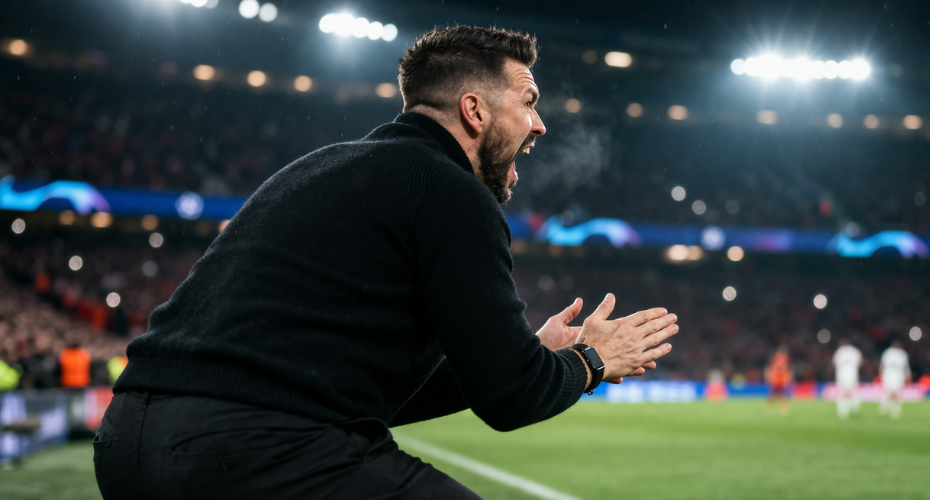
Italian football had a summer full of managerial change, but one of its sharpest young coaches was never truly part of the conversation.
While 12 of Serie A’s 20 clubs changed manager, Francesco Farioli was largely left outside the frame. For anyone watching European football closely, that says plenty. At 36, he has already built a reputation as one of the most progressive Italian coaches of his generation, yet the biggest openings in his home country passed him by. Instead, it is in Portugal, with Porto, where his rise has become impossible to ignore.
For football fans who love tracking the game beyond the obvious names, and for anyone drawn to the idea of football weekends abroad built around clubs with identity, pressure and expectation, Farioli’s story is one of the most interesting managerial arcs in Europe right now.
The Italian coach Serie A overlooked
Last summer, Serie A saw heavy movement in the dugout. Even so, Farioli remained on the outside looking in.
Some clubs perhaps knew they no longer had much chance of convincing him. His standing had already moved beyond the level of mid table projects or survival scraps. As for Italy’s traditional heavyweights and European hopefuls, most still leaned toward experience. Roles at clubs such as Milan and Inter may have been seen as arriving too early for Farioli, but that logic looked shaky when Inter turned to Cristian Chivu after just 13 senior games at Parma, following years in academy football.
It all underlined a broader point. Some of Italy’s most forward thinking coaches are now developing their best work abroad. Roberto De Zerbi, one of the most obvious examples, has not returned to Serie A since leaving for Shakhtar Donetsk in 2021. Since then, his career has continued in England and France.
Farioli has followed a similarly outward looking path, and it has rewarded him.
A coach willing to take the harder road
Rather than waiting for the right job in Italy to appear, Farioli went looking for opportunities elsewhere.
He stepped into senior management at 32 with Fatih Karagumruk in 2021 and then continued at Alanyaspor from 2021 to 2023. Both jobs came in Turkey, a league that can test far more than tactical ideas. Working there demanded flexibility, nerve and a willingness to take on responsibilities beyond the usual remit of a head coach.
That stretch mattered. It toughened him, broadened him and accelerated his development.
In a relatively short period, Farioli created more possibilities for himself than he may ever have had by sitting still and waiting for Italian football to catch up. He has also shown something that is often undervalued in coaching careers: an instinct for timing, and for choosing the right people and projects to move with.
Why Farioli leaves such a strong impression
Spend time around Farioli and it becomes easier to understand why clubs are drawn to him.
He presents as a modern football figure in every sense. He speaks fluent English, carries himself with calm authority and lacks the volatility often associated with some of the more theatrical names in Italian coaching. There is a composure to him, and a polish too. In temperament, he comes across as a gentleman, in the mould of Carlo Ancelotti.
His background also tells its own story. Time spent at Qatar’s Aspire Academy, an institution with historic links to Barcelona, showed how early he recognised where football was heading. He understood long before many others that the game was becoming more international, more connected and more open to hybrid ideas.
Even if the foundations of his football can still be read as distinctly Italian, the finished product has been updated for the modern game.
That appealed to Nice, who brought him in for the 2023 to 2024 season under the INEOS structure led by Sir Jim Ratcliffe and Dave Brailsford. It then appealed to Ajax, who appointed him in 2024 and made him the first Italian coach in the club’s history.
That was a fascinating fit. Ajax are one of the clearest ideological clubs in Europe, a side with a deep rooted football identity. Traditionally, that identity stands in contrast to the instincts of Italian football culture. But Farioli is not a conventional Italian coach. He sits outside that old framework.
Porto saw what others did not
While Serie A hesitated, Porto moved.
Club president Andre Villas-Boas identified Farioli’s talent and acted on it. There is a certain symmetry there. Villas-Boas was once the precocious young coach making the football world take notice. Now, as president, he has backed another coach whose rise has been defined by ambition and early achievement.
That relationship matters. Villas-Boas remains the youngest manager to win a major UEFA competition, having delivered Porto a league, cup and Europa League treble at 33. Long before he became club president in 2024, he had imagined one day leading the club from the boardroom. Choosing Farioli was part of that vision becoming real.
It was also a serious compliment to the Italian. Porto did not merely appoint a talented coach. They gave a major European club to a manager whose ideas, trajectory and personality matched the new direction of the institution.
What he achieved at Nice and Ajax
Before Portugal, Farioli had already left a clear mark in France and the Netherlands.
At Nice, he lifted the club from ninth in Ligue 1 to fifth. His side went unbeaten through his first 13 matches and were sitting in the Champions League places at Christmas. The momentum did not quite hold, but the broader context matters. Nice did not invest enough to maintain that push, with INEOS focused on completing its minority stake deal in Manchester United.
Then came Ajax.
The Dutch giants improved by 22 points under Farioli, and while attention naturally settled on the painful ending to the season, that should not overshadow the scale of the work he did there. Ajax were nine points clear with five games left and looked set for a first league title since Erik ten Hag’s final championship in 2021 to 2022. PSV eventually caught them in dramatic fashion, but the real story was that Ajax had even reached that position at all.
When Farioli arrived, the club was in chaos. The structure that had helped Ajax nearly reach the Champions League final in 2019 had been stripped away. Edwin van der Sar had stepped down as chief executive in the summer of 2023. Sporting director Marc Overmars had already resigned in scandal. Ajax had gone through four coaches in a single season and staggered to fifth place with their worst points total since 1965, using the modern three points for a win standard.
A title in Farioli’s first year would have bordered on the miraculous. He came remarkably close.
The picture becomes even clearer now. Ajax currently sit fourth, 20 points behind PSV. Rather than linger on what slipped away, Farioli moved forward.
Porto’s title push is more impressive than it looks
At first glance, leading Porto into a title race might not sound extraordinary. That view misses the context.
Last season, Porto were nowhere near the top level expected of them. Without Sergio Conceicao and Mehdi Taremi, they fell well behind the Lisbon clubs. Sporting CP finished 11 points clear as champions and then claimed another title without Ruben Amorim, underlining their grip on Portuguese football. Three championships in five years have marked Sporting out as the team of this era in Portugal, and their run to the quarter finals of this season’s Champions League only reinforced how hard they are to unseat.
Against that backdrop, Porto’s response under Farioli has been striking.
For much of this season they looked capable of matching Villas-Boas’ own unbeaten league campaign, only for Casa Pia to spring a surprise against 10 men in February. Porto took 49 points from a possible 51 in the first half of the season. The pace they set made life difficult for both Sporting and Benfica, who now trail by seven points, although Sporting do still hold a game in hand.
Farioli made his point early. Porto won their first nine matches in all competitions, setting the tone immediately.
That alone ensured he made a deeper impression than the previous Italian coach at Porto, Luigi Delneri, whose brief spell in the summer of 2004 ended before he even managed an official match after succeeding Jose Mourinho. Under Farioli and Villas-Boas, Porto feel aligned again. The new era is real.
A project he truly believes in
One of the most telling moments of Porto’s season came away from the pitch.
At the famous Lello bookstore in January, Farioli and Villas-Boas signed a contract extension through to 2028. It was symbolic as much as practical. After leaving Nice and Ajax after a single season each, Farioli is not treating Porto as another short stop on the journey. He believes in the project.
The club’s actions backed that up.
In the winter transfer window, Porto brought Thiago Silva back to European football, adding vast experience at centre back. That signing reflected a wider truth. Under Villas-Boas and Farioli, Porto have become an attractive destination again.
Jakub Kiwior’s loan move from Arsenal last summer was another example. The Poland defender had no shortage of options after making 44 Premier League appearances. Several Serie A clubs offered a route back to Italy, but he chose Porto instead. Alongside fellow Pole Jan Bednarek, whose eight years at Southampton brought significant Premier League experience, he has formed a formidable defensive pairing. Behind them is captain Diogo Costa, whom Farioli describes as “one of the best three goalkeepers in the world”.
Porto have conceded only seven open play goals in the league. Their defensive structure has found an excellent balance, allowing the fewest touches in their own penalty area while also making the most tackles in the final third.
More than just organisation and control
It would be easy to reduce Farioli’s Porto to defensive structure and discipline, but that would miss the bigger picture.
This is not the bruising Porto of the Conceicao era, even if the team still carries plenty of physical power and athleticism. Victor Froholdt can cover ground and drive through midfield. Pablo Rosario, a player Farioli already knew from Nice, brings tactical flexibility. Samu Omorodion has developed his game too, improving his ability to drop short, combine with others and play with his back to goal.
Even a major setback did not derail Porto’s season. When Samu suffered an anterior cruciate ligament injury against Sporting in February, Porto kept pushing.
Farioli has handled the ups and downs impressively. When Borja Sainz’s form faded, 17 year old Oskar Pietuszewski, signed in winter from Jagiellonia Bialystok, stepped up. He helped cover some of the missing goals, with Samu having already scored 20, while Deniz Gul and Terem Moffi, another player previously coached by Farioli at Nice, took on the less glamorous tasks that had helped the Spaniard’s all round contribution.
Sporting may still offer more entertainment in the eyes of some, particularly with creators such as Gabri Veiga or Rodrigo Mora operating between the lines, but there is still plenty of invention in Farioli’s Porto.
The “Creators’ Lab” and a modern football mind
One detail captures Farioli’s approach better than most.
He runs a WhatsApp group called the “Creators’ Lab”, effectively a private research and development unit. Analysts who are separate from his coaching staff track trends, ideas and tactical developments across other leagues, then share them for him to study, adapt and refine.
That says a lot about the way he thinks.
Farioli is not simply a coach with a fixed system. He is constantly scanning, absorbing and evolving. For clubs looking to stay ahead, and for supporters who appreciate managers bringing fresh ideas rather than just recycled habits, that makes him especially compelling.
Italy’s loss, Portugal’s gain
For now, Francesco Farioli’s story belongs to Portuguese football, not Italian football.
Serie A may have overlooked one of its most gifted young coaches, but Porto have benefited from that hesitation. His journey through Turkey, France, the Netherlands and now Portugal has shaped a manager who feels distinctly modern, calm under pressure and ambitious without noise.
For football fans who care about where the game is going, not just where it has been, Farioli is a name worth following closely. And for anyone drawn to the appeal of European football travel, of seeing major clubs in serious moments and soaking in the atmosphere of a live football travel experience, Porto under Farioli now offers one of the most interesting football stadium experiences on the continent.