

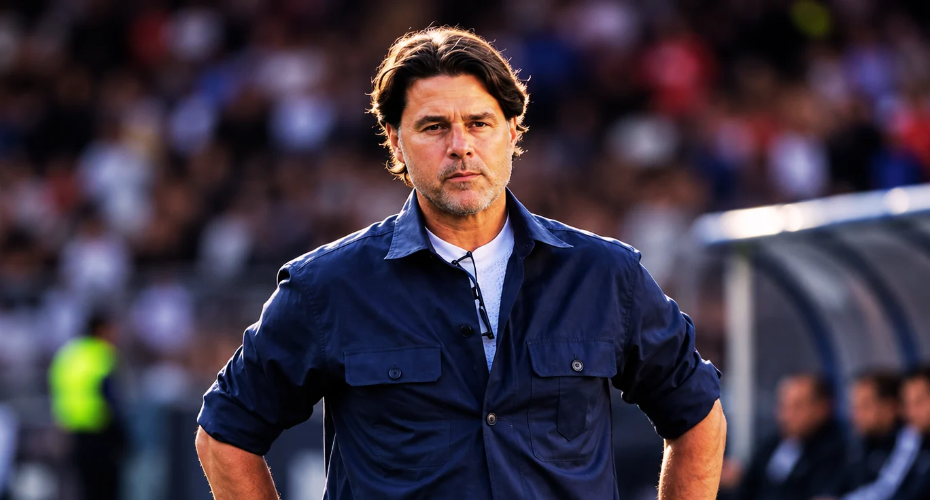
Mauricio Pochettino and Manchester United have been circling each other for more than a decade.
His name was first linked with the job years ago. Since then, United have burned through five permanent managers or head coaches and three temporary appointments, while Pochettino has taken Tottenham to a Champions League final, managed Paris Saint Germain and Chelsea, and most recently guided the United States into the knockout stages of a largely home World Cup.
Now, after years of almosts, detours and different directions, the possibility of Pochettino finally taking charge at Old Trafford is being considered again.
United are finalising a deal that would make him their next head coach if Michael Carrick leaves.
On reputation alone, the appointment would make sense. Pochettino has managed almost 500 matches across Europe’s top five leagues and another 45 in the Champions League. The more interesting question is what his football would actually look like with this Manchester United squad.
There are reasons to think the fit could work.
Pochettino has always trusted young players
One of Pochettino’s most consistent strengths has been developing young footballers.
At Tottenham, players including Harry Kane, Dele Alli, Ryan Mason, Danny Rose and Kyle Walker all made major strides under him.
At Southampton, Luke Shaw and Adam Lallana flourished.
Shaw could now potentially be reunited with Pochettino at United, 13 years after they first worked together.
That track record matters because Manchester United currently have a group of young players who have often been caught inside the wider instability surrounding the first team.
Nine players under the age of 24 have appeared for United this season.
Among them are Leny Yoro, Kobbie Mainoo, Shea Lacey and Carlos Baleba, all of whom could benefit from a manager whose history suggests age alone will never stop a player getting minutes.
Pochettino has always been clear on that.
“I am not afraid to play them,” said Pochettino. “If a player deserves to play, if they are 17, 18, 19, or 20, it is the same for us (him and his coaching staff), as long as they show character and maturity to be given the responsibility.
“The younger player needs faith in them, and you need to translate that feeling that you believe in them. They need to believe that you believe.”
For a United squad searching for direction, that philosophy could matter just as much as any formation.
His man management has always been a major strength
Former players have regularly spoken positively about Pochettino’s ability to manage individuals.
His approach tends to be personal, detailed and built around understanding what a player can become rather than simply what he already is.
He once used Eric Dier as an example.
“When we signed him, the first game he played against West Ham and after was centre-back, then full-back, and then this season we started to train with him as a holding midfielder. I think it is a fantastic position for him.”
That willingness to reshape players is significant.
United have several footballers who have been shuffled between roles, systems and managers over recent seasons. Pochettino’s history suggests he would not necessarily view that uncertainty as a problem.
He might see it as an opportunity.
For younger players in particular, that could bring some much needed clarity.
High pressing would become central again
Pochettino’s football has traditionally been built around energy.
His teams press high.
They try to win the ball close to the opposition goal.
They are expected to play with intensity and aggression without possession.
That philosophy was heavily shaped by Marcelo Bielsa, who coached Pochettino during his playing career.
It is another reason younger players often appeal to him.
They tend to have the energy to execute those demands and the motivation to absorb detailed coaching.
At Chelsea, his team ranked fifth in the Premier League for high turnovers during the 2023 24 season.
Their overall intensity rating compared with teams across Europe’s top seven domestic leagues was 89 out of 99.
That tells you what Pochettino wants.
He wants his teams moving forward.
He wants pressure.
He wants players willing to run.
His PSG experience also taught him about balance
That pressing philosophy has not always been easy to impose.
At Paris Saint Germain, Pochettino worked with Lionel Messi, Kylian Mbappe and Neymar in the same forward line.
He later suggested there was “too much greatness” within that attack to build the kind of defensive cohesion he normally wants from a team.
That experience matters because it shows the limits of any tactical philosophy.
A manager can want intensity.
The squad still has to be capable of producing it.
At Manchester United, Pochettino would inherit players with very different qualities and physical profiles. His challenge would be finding a version of his football that suits them rather than simply attempting to recreate Tottenham.
His Chelsea side attacked well but conceded too much
Pochettino’s season at Chelsea provides one of the clearest recent examples of both the strengths and weaknesses of his approach.
Chelsea scored 77 Premier League goals.
Only two Chelsea sides have produced more in a league season.
Antonio Conte’s champions in 2016 17.
And Carlo Ancelotti’s title winners in 2009 10.
That is impressive company.
Cole Palmer was central to the attacking output, scoring 22 goals and providing another 11 assists in his first season at the club.
Pochettino found a structure that allowed Palmer to become the attacking reference point.
That part of his Chelsea spell should interest United.
Bruno Fernandes, Bryan Mbeumo and Matheus Cunha all possess qualities that could thrive in an attack with greater freedom and structure around them.
The defensive numbers were much less encouraging.
Chelsea conceded 63 league goals.
Their Chance Prevention rating was only 32 out of 99.
That suggests any idea of Pochettino instantly fixing United would be unrealistic.
He might improve the attack quickly.
Making the side stable would probably take longer.
United would need patience
That is probably the central point.
Pochettino is not necessarily a manager who arrives, tightens everything immediately and turns a struggling side into something conservative and difficult to beat.
His teams usually require time.
Players need to understand the pressing triggers.
They need to learn where teammates will move.
They need confidence playing through pressure.
At United, those details would have to be rebuilt inside a squad that has already absorbed ideas from several different managers.
There are still signs of previous tactical systems everywhere.
That is rarely easy to untangle.
If Pochettino does arrive, the first months may be about establishing a new identity rather than chasing immediate perfection.
Pochettino wants patient build up through midfield
With the ball, his football is more controlled than the pressing reputation sometimes suggests.
Pochettino generally wants his teams to build patiently through the middle of the pitch.
He asks defenders to be brave in possession.
Rather than avoiding opposition pressure, he often wants his team to invite it.
The idea is to draw opponents forward and then play through them.
That requires technically secure midfielders who can receive under pressure and move the ball forward quickly.
At his best, Pochettino creates teams capable of turning a slow build up into a dangerous attack in a few passes.
For United, Mainoo and Baleba could become particularly important in that kind of structure.
He is tactically more flexible than people sometimes assume
Pochettino is often associated with a 4 2 3 1 system.
Four defenders.
Two deeper midfielders.
One creative player operating behind the striker.
That remains his natural starting point.
But he has used other shapes throughout his career.
At Tottenham, he experimented with three defenders.
More recently, with the United States, he has again shown a willingness to alter the structure depending on the opponent and the players available.
That flexibility could be important at United.
The squad does not currently scream one obvious formation.
Several players can occupy multiple positions.
Others clearly suit some systems more than others.
Pochettino has rarely been completely dogmatic about the starting shape.
His United States side shows how he wants to build attacks
A recent match against Portugal gives a useful example.
The United States shifted into a 3 2 5 shape during build up.
Antonee Robinson moved high on the left.
Alex Freeman moved inside from the opposite side.
Two midfielders stayed close enough to combine through central areas.
Further forward, Weston McKennie, Christian Pulisic and Malik Tillman rotated positions, attacked the space behind the defence and dropped into pockets.
It created movement everywhere.
That positional fluidity is important to Pochettino.
He wants players to recognise space rather than simply occupy one fixed zone.
That could suit United’s more versatile attackers.
The United States have become much braver in possession
There has been a clear change in how the United States play from the back since Pochettino took charge.
They are much more comfortable attempting to play through pressure.
A sequence against Japan last year showed the idea clearly.
Pulisic dropped deeper to help the defenders progress the ball.
Full back Max Arfsten then moved into the space Pulisic had vacated.
A forward pass broke pressure.
Folarin Balogun produced a quick lay off.
Arfsten escaped into space and started the counter attack.
Pochettino applauded from the touchline.
The sequence demonstrated something important.
His possession football is not simply about keeping the ball.
The point is to manipulate the opposition until space appears.
Then attack it.
He knows when playing out is too risky
Pochettino is not completely wedded to playing from the back regardless of circumstances.
That matters at United.
Building possession under pressure requires confidence.
If players are nervous or technically uncomfortable, continually asking them to take risks can make things worse.
Pochettino has shown he understands that.
His long term aim would probably be a United side capable of moving confidently through all three thirds.
But he has also shown a willingness to adapt while a team is developing.
That pragmatism could be important during the early stages of the job.
Counter attacking remains a major weapon
At Chelsea, Pochettino did not ignore transition football while trying to establish a more controlled possession game.
He used Palmer and Nicolas Jackson to attack space quickly whenever Chelsea won the ball.
Over the course of the 2023 24 season, their threat from fast breaks increased significantly.
Only four Premier League teams generated more shots from counter attacking situations.
That could translate naturally to the current Manchester United squad.
Fernandes sees early passes.
Mbeumo can attack space.
Cunha is comfortable carrying the ball in transition.
United may eventually want to dominate matches through possession, but those attacking qualities already exist.
Pochettino could use them while the wider structure develops.
For supporters drawn to unpredictable fixtures and the different styles encountered on football weekends abroad, Secret Match Day’s Original Mystery football trip is built around that same idea of not quite knowing what sort of match or football experience will be waiting until the reveal.
Old Trafford could suit his emotional style of management
There is another part of the potential fit that has little to do with formation.
Pochettino has always been an emotional manager.
He wants a connection between players and supporters.
His best Tottenham team had that.
The club felt united behind the side.
The football was aggressive.
The players looked invested.
The crowd responded.
At Old Trafford, rebuilding that relationship would be a major part of the job.
A football stadium experience changes completely when supporters believe in the direction of the team.
United have often lacked that sense of momentum in recent years.
Pochettino has created it before.
His Southampton and Tottenham work remains his strongest argument
Pochettino’s wider managerial record is substantial, but his work in England remains especially relevant.
At Southampton, he made a lasting impression with a newly promoted club.
At Tottenham, he eventually delivered a record points total and took the club to a Champions League final.
That period created a relationship with Tottenham supporters that still exists today.
He did not win the major trophies many expected.
That remains the most obvious criticism of his career.
But silverware may not be the immediate priority at Manchester United.
Right now, the club needs something more fundamental.
A direction.
The lack of trophies matters less than it once did
Pochettino’s critics will point to his trophy record.
That is fair.
For a manager who has spent so long around elite clubs, the silverware return is relatively modest.
He won his only league title while managing PSG.
But United are not currently choosing between managers who can guarantee a title next season.
The problems run deeper.
The immediate job is rebuilding the team.
Developing younger players.
Restoring some tactical consistency.
Creating a style supporters can recognise.
Getting different personalities pulling in the same direction.
Pochettino has evidence of doing all of those things.
Healing the squad could be his biggest task
United’s problems have not only been tactical.
There have been visible divisions and periods where the squad has looked like a collection of individuals rather than a coherent team.
Pochettino’s strongest sides have generally been built through relationships.
Players understand their role.
They understand the collective demands.
And they believe the manager is invested in improving them.
That does not guarantee success.
Nothing at Manchester United seems to.
But it does offer a believable starting point.
Why Pochettino may finally make sense for Manchester United
The timing is almost strange.
Pochettino has been linked with Manchester United so often that the idea once felt inevitable.
Then it faded.
His career moved through Paris, Chelsea and the United States.
United kept changing managers.
Now they have somehow arrived back at the same conversation.
Yet perhaps the fit makes more sense now than it would have a decade ago.
United need a coach rather than simply a huge managerial personality.
They need someone comfortable developing young players.
They need tactical flexibility.
They need an attacking identity without ignoring transition football.
And they need somebody capable of rebuilding confidence in a club that has spent too long searching for the next solution.
Pochettino would not arrive with guarantees.
His Chelsea defence showed the risks.
His trophy record will remain a talking point.
And any rebuild at United would require patience.
But if the priority is to make Manchester United feel like a functioning football team again before worrying about everything else, there is a strong case that Mauricio Pochettino could be the right kind of appointment at exactly the right time.